
[ad_1]
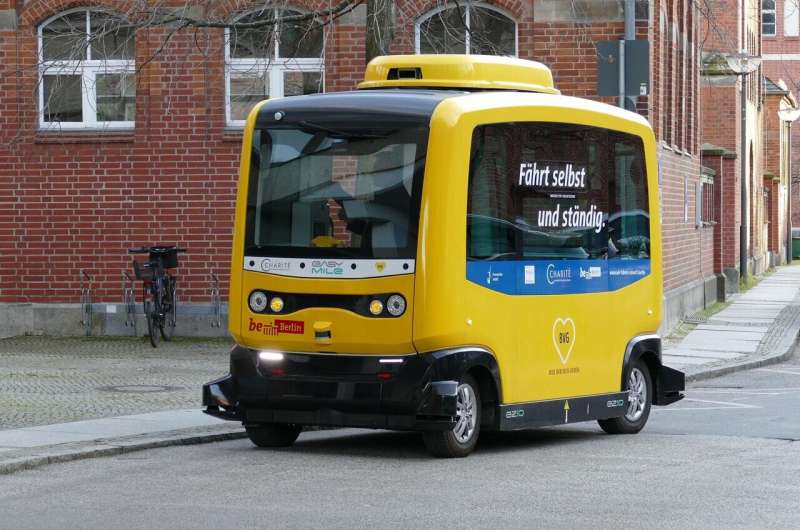
An autonomous vehicle is capable to navigate town streets and other considerably less-chaotic environments by recognizing pedestrians, other motor vehicles and possible hurdles through artificial intelligence. This is attained with the help of synthetic neural networks, which are qualified to “see” the car’s surroundings, mimicking the human visible notion process.
But compared with humans, vehicles utilizing synthetic neural networks have no memory of the earlier and are in a continuous state of seeing the world for the initial time—no issue how many occasions they have pushed down a certain street right before. This is significantly problematic in adverse climate disorders, when the car or truck simply cannot safely depend on its sensors.
Scientists at the Cornell Ann S. Bowers College or university of Computing and Info Science and the Faculty of Engineering have generated 3 concurrent investigate papers with the purpose of beating this limitation by providing the auto with the skill to make “memories” of former activities and use them in long term navigation.
Doctoral college student Yurong You is direct writer of “HINDSIGHT is 20/20: Leveraging Past Traversals to Assist 3D Perception,” which You introduced pretty much in April at ICLR 2022, the International Conference on Mastering Representations. “Discovering representations” contains deep finding out, a sort of device mastering.
“The fundamental query is, can we discover from repeated traversals?” mentioned senior author Kilian Weinberger, professor of personal computer science in Cornell Bowers CIS. “For illustration, a car or truck may slip-up a weirdly shaped tree for a pedestrian the to start with time its laser scanner perceives it from a length, but at the time it is close enough, the item class will turn into obvious. So the second time you generate previous the quite exact tree, even in fog or snow, you would hope that the car or truck has now figured out to recognize it effectively.”
“In reality, you almost never drive a route for the really very first time,” explained co-writer Katie Luo, a doctoral scholar in the investigation group. “Both you you or someone else has pushed it before just lately, so it seems only normal to gather that practical experience and benefit from it.”
Spearheaded by doctoral university student Carlos Diaz-Ruiz, the team compiled a dataset by driving a vehicle equipped with LiDAR (Gentle Detection and Ranging) sensors consistently together a 15-kilometer loop in and all-around Ithaca, 40 periods over an 18-month time period. The traversals seize various environments (freeway, urban, campus), weather conditions situations (sunny, wet, snowy) and occasions of working day.
This resulting dataset—which the team refers to as Ithaca365, and which is the subject matter of a person of the other two papers—has additional than 600,000 scenes.
“It deliberately exposes just one of the crucial worries in self-driving automobiles: very poor weather conditions circumstances,” reported Diaz-Ruiz, a co-creator of the Ithaca365 paper. “If the road is coated by snow, human beings can rely on reminiscences, but without reminiscences a neural community is intensely deprived.”
HINDSIGHT is an tactic that uses neural networks to compute descriptors of objects as the car or truck passes them. It then compresses these descriptions, which the team has dubbed SQuaSH (Spatial-Quantized Sparse History) capabilities, and merchants them on a virtual map, similar to a “memory” stored in a human brain.
The subsequent time the self-driving car or truck traverses the exact same place, it can query the community SQuaSH database of every single LiDAR point along the route and “recall” what it figured out past time. The database is continuously updated and shared across motor vehicles, hence enriching the information readily available to conduct recognition.
“This information and facts can be added as attributes to any LiDAR-based mostly 3D object detector” You stated. “Both of those the detector and the SQuaSH illustration can be properly trained jointly with out any added supervision, or human annotation, which is time- and labor-intense.”
Whilst HINDSIGHT still assumes that the artificial neural community is by now skilled to detect objects and augments it with the functionality to build recollections, MODEST (Cellular Object Detection with Ephemerality and Self-Coaching)—the subject of the third publication—goes even additional.
Right here, the authors allow the vehicle learn the whole perception pipeline from scratch. Initially the synthetic neural network in the auto has in no way been uncovered to any objects or streets at all. By numerous traversals of the very same route, it can understand what components of the surroundings are stationary and which are transferring objects. Slowly and gradually it teaches itself what constitutes other website traffic contributors and what is safe and sound to disregard.
The algorithm can then detect these objects reliably—even on roads that have been not element of the preliminary repeated traversals.
The scientists hope that both ways could considerably cut down the growth price of autonomous automobiles (which at present nevertheless depends closely on highly-priced human annotated info) and make such motor vehicles extra effective by understanding to navigate the locations in which they are employed the most.
Both Ithaca365 and MODEST will be presented at the Proceedings of the IEEE Conference on Laptop Vision and Pattern Recognition (CVPR 2022), to be held June 19-24 in New Orleans.
Other contributors include things like Mark Campbell, the John A. Mellowes ’60 Professor in Mechanical Engineering in the Sibley School of Mechanical and Aerospace Engineering, assistant professors Bharath Hariharan and Wen Sun, from personal computer science at Bowers CIS previous postdoctoral researcher Wei-Lun Chao, now an assistant professor of personal computer science and engineering at Ohio State and doctoral pupils Cheng Perng Phoo, Xiangyu Chen and Junan Chen.
New way to ‘see’ objects accelerates foreseeable future of self-driving automobiles
Convention: cvpr2022.thecvf.com/
Citation:
Technology allows self-driving cars discover from their individual reminiscences (2022, June 21)
retrieved 26 June 2022
from https://techxplore.com/news/2022-06-technologies-self-driving-vehicles-reminiscences.html
This doc is issue to copyright. Apart from any fair working for the goal of personal research or investigate, no
aspect may possibly be reproduced without the need of the created permission. The content is offered for details functions only.
[ad_2]
Resource url
About the Author


